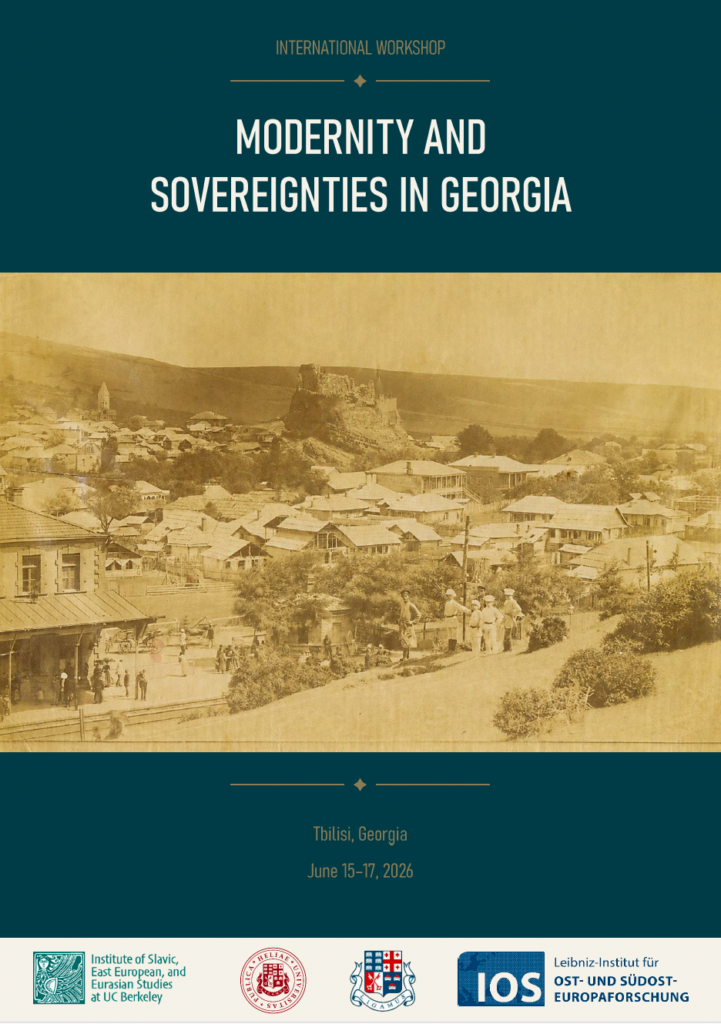
The workshop was held at Ilia State University from June 15 to June 17. It brought together approximately twenty scholars from the social sciences and humanities working in Georgia, Europe, and North America. Its subject was Georgia’s modern history as an unusually rich site for re-examining the relationship between sovereignty and modernity. Over the two centuries separating tsarist annexation from the post-Soviet present, Georgia has traversed multiple political systems — from empire to state socialism to social democracy to its current incorporation as a peripheral state into the neoliberal global order — and this compressed, turbulent trajectory supplied both the empirical grounding and the analytical stakes of the gathering.
The workshop took as its two conceptual axes the ongoing debate over singular and multiple modernities and recent scholarly reflection on the concept of sovereignty. It asked whether the Georgian case is best understood as part of a radically uneven but nonetheless unified process of global modernization, or as the manifestation of an alternative modernity realized primarily through local appropriation and adaptation. Rather than accepting the classical definition of sovereignty as the apex of state power, the workshop asked how competing actors — state and non-state, national and regional, cultural and political — have claimed or enacted authority during those prolonged periods when the Georgian nation-state was absent or only nominally present. The workshop encompassed four thematic panels, a keynote lecture, and a concluding public event addressing the pressures currently bearing on academic freedom and institutional autonomy — in Georgia and beyond.
Panels:
The first panel, moderated by LUKA NAKHUTSRISHVILI (Tbilisi), set the terms of the discussion by tracing the concept of sovereignty from the early modern period into the modern era. NIKOLOZ ALEKSIDZE (Tbilisi) argued that from the fourth century onward, saintly remains and associated objects served as instruments of political and dynastic legitimacy across the Roman Empire and the broader Christian world — a function particularly pronounced in early medieval Caucasia. Examining how the circulation of relics featured in diplomatic negotiations between Georgian polities and Muscovy, Aleksidze proposed the analytical pair “Imperial Taking” and “Imperial Giving” to describe a rhetorical exchange whereby the “inauthentic” political sovereignty of the Georgian kingdoms was traded for an “authentic” religious identity, materialized in objects such as the Cross of St. Nino and the Icon of Blachernae.
ZAAL ANDRONIKASHVILI (Berlin) asked how political domination under Russian rule failed to translate into cultural hegemony, and how cultural authority could be reconstituted and made politically effective even under conditions of lost statehood. Drawing on Guha, Said, and Gramsci — and reading them against Schmitt’s critique of political romanticism — he argued that in the Georgian case sovereignty was reconstituted in a divided form: its substantive ground relocated to_ mamuli_, the homeland as an enduring locus of collective continuity, while its representative function was assumed by the poet as the bearer of auctoritas rather than potestas.
The theme of archaism and modernity was continued by HARSHA RAM (Berkeley), who reconstructed the symbolic structure and cultural reception of the Surami fortress legend — a folktale whose literary adaptation by Daniel Chonkadze marks the beginnings of modern Georgian prose. Ram argued that the legend’s tale of ritual human immurement both affirms Georgian sovereignty and exposes its points of narrative tension and social fracture, tracing its reception through the polemics of the late imperial era and culminating in Pilipe Makharadze’s essay on Chonkadze — arguably the first piece of sustained Marxist literary analysis to have arisen in the Russian Empire.
The panel was closed by GIORGI MAISURADZE (Tbilisi), who pushed the panel’s thematic arc into the Soviet period. Maisuradze examined how the forced modernization of the 1930s — collectivization and rapid industrialization — was accompanied in the Soviet constituent republics by a form of cultural archaization. In western Georgia, the development of agricultural land coincided with the rediscovery of the myth of Colchis and Jason and the Argonauts, as the geographical designation “Colchis Lowlands” superimposed a layer of Greek mythology onto the landscape of socialist transformation.
The second panel brought together three case studies examining sovereignty as enacted not by or within the state but through local, religious, and transgressive formations at its edges. NUTSA BATIASHVILI (Tbilisi) examined how practices of guarding and caring for local heritage in Upper Svaneti constituted a form of political ecology organized around the concept of gandzi, or treasure. Batiashvili argued that these practices are not stabilizing acts but modes of inhabiting “sovereignty on the verge” — a condition in which authority is never fully consolidated but remains distributed, contested, and continuously renegotiated across overlapping regimes of power.
From Svaneti, the panel moved to Tusheti with FLORIAN MÜHLFRIED (Tbilisi), who traced the transformation of a sacred site in Omalo from Soviet state-centred sovereignty — articulated through both violence and developmental care — to dispersed forms enacted by the Georgian Orthodox Church, private capital, and local practices.
JONAS LÖFFLER (Tbilisi / Vienna) closed the panel by recovering a shared heritage of masculine criminal figures across the linguistic, national, and imperial fractures of the South Caucasus — from the Persianate luti / lotu and the mountain bandit abrek, through the Gurian pirali and the Bakuvian qoçu, to the pan-Soviet vor v zakone — and called for an entangled cultural history of the region and a history of Caucasian masculinity.
The third panel opened the second day of the workshop, moderated by Harsha Ram, concentrating on the late imperial and revolutionary decades of the early twentieth century. IA ERADZE (Tbilisi) traced the relationship between finance, modernity, and sovereignty across three historical periods, arguing that the first saadgilmamulo (noble) banks of the Russian imperial period functioned not merely as financial institutions but as instruments of nation-building and economic self-organisation. In the Georgian Democratic Republic (1918–1921), central banking formed part of a broader project of institutionalizing economic sovereignty, while in the post-Soviet period banks became agents of marketization that hollowed out the economic dimension of sovereignty, reducing it to political and populist rhetoric.
The panel continued with Luka Nakhutsrishvili, who explored the competing grammars of legitimacy articulated in the Menshevik-led Georgian Democratic Republic’s Constituent Assembly debates, print media, and unpublished documents, proposing the notion of “revolutionary sovereignty” to capture the short-lived attempt of a small country to navigate multiple legacies, threats, territorialities, and dependencies simultaneously. The paper foregrounded unresolved tensions between rival claims: was the GDR a “nation-state” grounded in Georgia’s historical right of sovereignty, or a “democratic republic” deriving its authority from the values of the February Revolution and the broader European revolutionary tradition?
HARRISON KING (Berkeley) examined the activities of the Committee for the Liberation of Muslim Georgia — formed in Tbilisi in May 1918 and committed to integrating the Muslim-majority borderland regions of Ajara and Meskheti into the GDR on an autonomous basis — arguing that Ajaran autonomy was not a Bolshevik invention but a contested political project whose principal engineers were Ajarans themselves.
The panel was concluded by DŮŠAN RADUNOVIĆ’S (Durham) account of the penetration of LEF (Left Front in Art) ideas into the Georgian national film studio in (or around) 1927, situating this “takeover” against two interlocking pressures: the tension between sovereignty and political legitimacy in Georgia after 1921, and the fundamental crisis of the global and Soviet modernist paradigm by the end of the 1920s.
The second day concluded with the keynote lecture by RONALD GRIGOR SUNY (Michigan) who discussed the imperial effects of tsarism and Soviet “socialism” on the formation of the Georgian nation and the limits on sovereignty and modernity that living in those empires produced. His lecture offered a panoramic interpretation of the long-term consequences of imperial rule for Georgia’s present, framing the country’s contemporary crises as the return, in part, of historically accumulated structures and tensions.
The fourth and final panel, moderated by Guido Hausmann (Regensburg), turned to questions of spatial and material formation, asking how specific sites — public gardens, mountain peaks, and resource extraction frontiers — carried and produced forms of modernity and sovereignty. PAUL MANNING (Ontario) traced the emergence of the Georgian newspaper feuilleton in the pages of Droeba (founded in 1866) and its constitutive relationship with the public gardens of Tbilisi and Kutaisi, arguing that the feuilleton — a digressive urban genre organized around flâneuristic walking and overheard conversation — transformed the material spaces of the city into literary topoi and made urban space a medium through which the Georgian intelligentsia negotiated its own identity and cultural authority.
GIORGI TSINTSADZE (Providence) traced the transformation of the European cultural imaginary of the Caucasus through Douglas Freshfield’s travelogues and Vittorio Sella’s photographs, showing how science, aesthetics, and imperial imagination mutually constituted one another in producing the Caucasus as an object of modern knowledge.
Finally, TAMAR QEBURIA (Regensburg) argued that the manganese deposits of Chiatura constituted a pivotal node in the late nineteenth-century proliferation of resource frontiers across the globe. Unlike Baku oil or Donbas coal, Chiatura manganese was produced exclusively for export, organized around small artisan-miners whose ore passed through Batumi or Poti to European markets. The South Caucasus — administered, legible, closed as a political periphery — simultaneously became a contact zone where empire and capital, colonial administration and emerging nationalist grievance, met and collided.
Public Event:
The workshop concluded with the public event “Our Current Moment: Three Perspectives from Three Disciplines,” held at Ilia State University and moderated by Luka Nakhutsrishvili. Harsha Ram, Florian Mühlfried, and Ia Eradze framed the contemporary moment as one characterized simultaneously by fragmentation and convergence, in which Georgia appeared at once as a peripheral outlier and as a mirror reflecting and refracting much larger processes. Each speaker addressed this situation from a distinct vantage point — geographical location, institutional affiliation, and disciplinary training — generating a conversation that moved between geopolitical analysis, anthropological observation, and political-economic diagnosis. The event drew an audience beyond the workshop’s academic participants, opening the scholarly discussion to a broader public.
The workshop “Modernity and Sovereignties in Georgia” demonstrated the analytical productivity of placing Georgia in dialogue with global debates about modernity, sovereignty, and empire rather than treating it as an exotic exception or a mere illustrative case. From hagiography to Alpine modernity, from medieval relics to manganese ore, from the Menshevik Constituent Assembly to post-Soviet highland shrines, the papers collectively showed that the Georgian case generates theoretical insights of broader significance. Two cross-cutting tensions proved particularly generative throughout the three days: whether Georgian modernity is best understood as imposed from without or appropriated and transformed from within; and whether sovereignty is best conceived as a property of states or as a more dispersed, relational, and performative condition. Both resisted easy settlement, opening onto further questions about the relationship between cultural and political authority, imperial legacies and post-Soviet presents, and local case studies and global historiographical frameworks. The organizers intend for this first workshop to serve as the foundation for an ongoing collaborative research programme.
Conference Overview
Panel I: Archaism and Modernity
Luka Nakhutsrishvili (Tbilisi): Moderation
Nikoloz Aleksidze (Tbilisi): The Cult of Saints and the Rhetoric of Sovereignty
Zaal Andronikashvili (Berlin): Divided Sovereignty beyond the State: Culture, Representation, and Hegemony in Nineteenth-Century Georgia
Harsha Ram (Berkeley): The Collapsing Fortress: The Surami Legend and the Aporias of Georgian Sovereignty
Giorgi Maisuradze (Tbilisi): Colchis and Kolkhoz: The Archaizing Modernization of Soviet Georgia
Panel II: On the Margins of the State
Luka Nakhutsrishvili (Tbilisi): Moderation
Nutsa Batiashvili (Tbilisi): Sovereignty on the Verge in Upper Svaneti
Florian Mühlfried (Tbilisi): Syncretic Sovereignty: Care, Capital, and Religion in Highland Georgia
Jonas Löffler (Tbilisi / Vienna): Outlaws across Empires and Nations: The Veneration of Criminals in the South Caucasus from 1800 to Post-Soviet Times
Panel III: Between Empire and Revolution
Harsha Ram (Berkeley): Moderation
Ia Eradze (Tbilisi): Modernity and the Changing Forms of Sovereignty in Georgia through the Lens of Finance (Late Tsarist to the Menshevik Period)
Luka Nakhutsrishvili (Tbilisi): Revolutionary Sovereignty: Negotiating the Sources of Legitimacy in Menshevik Georgia
Harrison King (Berkeley): Long Live Muslim Georgia! Visions of Muslim Autonomy under Ottoman and British Occupation and Georgian Rule, 1918–21
Důšan Radunović (Durham): Vernacularising the Left Front: LEF, Sakartvelos Sakhkʿinmretsʼvi, and the Fractures of Georgia’s First Modernism
Keynote Lecture
Harsha Ram (Berkeley): Moderation
Ronald Grigor Suny (Michigan): History’s Revenge: Tsarist and Soviet Legacies in Georgia in the Twenty-First Century
Panel IV: Place, Space, Scale
Guido Hausmann (Regensburg): Moderation
Paul Manning (Peterborough): The Gardens and Intelligentsias of Two Cities: Kutaisi and Tbilisi
Giorgi Tsintsadze (Providence): Multimedia Modernity: Douglas Freshfield’s Caucasus and the Alpine Enlightenment
Tamar Qeburia (Regensburg): Georgia’s Manganese in the World Market: The Making of a Resource Frontier in the Late Nineteenth-Century South Caucasus
Public Event: Our Current Moment: Three Perspectives from Three Disciplines
Luka Nakhutsrishvili (Tbilisi): Moderation
Harsha Ram (Berkeley) / Florian Mühlfried (Tbilisi) / Ia Eradze (Tbilisi): Speakers