

On November 27, at 7 pm Tbilisi time, the biweekly research colloquium of the Institute for Social and Cultural Research, Ilia State University, will host Ruslana Bovhyria with a talk on her current research project: “The Property Frontier of Empire: Resource Extraction, Colonial Labour, and Imperial Territorialization in the Russo-Iranian Borderland, 1870s-1910s”.
Abstract:
Some of the most important actors in the last few decades of Russian colonial expansion to Central Asia were neither states nor merchants, but hybrid entities representing a combination of both. This claim becomes evident once we shift our attention from the core agricultural provinces of Turkestan to the remote borderland stretching across the Atrek und Gurgen rivers. In this country, perched on the extreme edges of Russia and Iran, the Lionozov Company came to wield more political and military power than any of the sovereign states. Around 1870, the company initiated an intensive fishing venture in the southeastern Caspian river deltas. With the acquiescence of the Qajar government, it was allowed to purchase land, dispense justice, and collect revenue from nomadic tribes. Lacking technical expertise, Lionozov recruited skilled workers from across the sea while procuring indigenous labourers to meet the physical demands in the tropical environment. By the early 1910s, the enterprise had become central to Tsarist settler-colonial campaigns in northern Persia.
The records of the Lionozov Company stand out among many peripheral stories of capitalism as they encourage some scepticism about the enduring geographic, conceptual, and political metrics that have tended to frame our thinking about empires. Moreover, they invite us to reckon with the fact that company-states and their nineteenth-century emulations were more the rule than the exception in the history of Russian imperialism. Drawing on diverse regional sources from Kazakh and Uzbek archives, this talk will examine the role of the Lionozov Company in building a distinct property regime on the South Caspian frontier.
Bio:
Ruslana Bovhyria is a historian specializing in Russian and Soviet Central Asia. Her research focuses on colonial property regimes, resource extraction, and environmental issues. At the Institute of East European Studies, Freie Universität Berlin, she is currently working on a book project tentatively titled Ambivalent Spaces of Empire. Lionozov Enterprise and the Making of an Imperial Borderland in Central Asia, 1818-1925.
The event will take place in English via Zoom. Registration is required.
To register please follow this link.
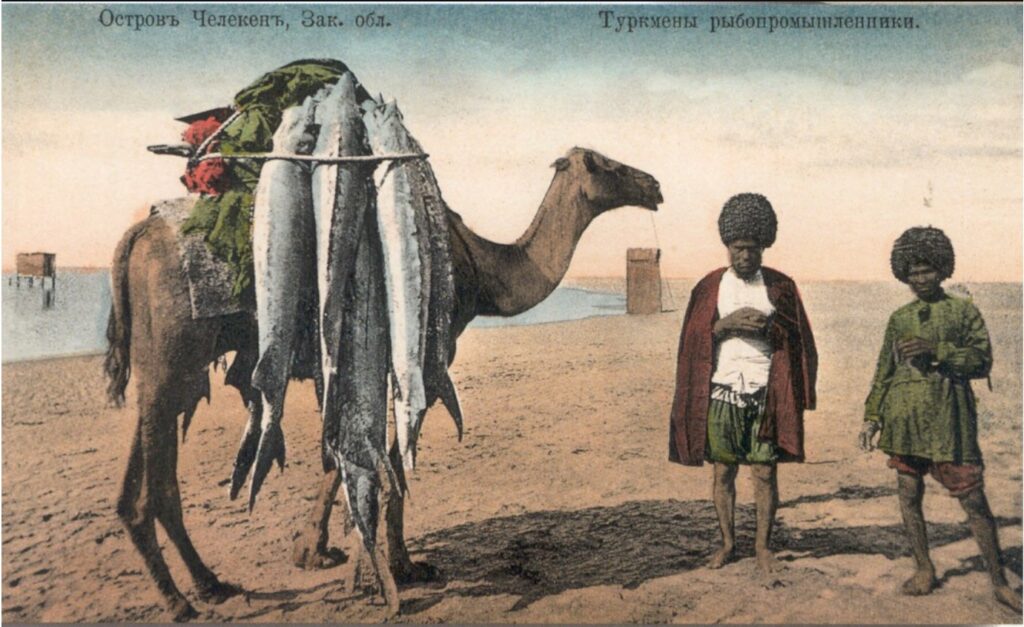
Photo: Turkmen fishermen of the Cheleken Peninsula, 1910
Source: Gordon Edmondson Private Sturgeon Collection, Vancouver Island University